Send it the files.
Get finished work back.
It does the jobs you would hand a junior analyst. Clean up the export, build the model, write the report, make the deck. It works from the files you give it, and it holds no keys to your accounting system, your bank or your email.
March 2026 Operating Account Review
One-page summary · built from a 263-row export
Ace Refrigeration was paid twice on the same day for the same amount: a duplicate $1,450.00 vendor payment nobody asked it to look for.
march_ledger.csv · rows 262–263| # | date | description | amount |
|---|---|---|---|
| 260 | 2026-03-30 | Vendor payment 298 US Foods | -412.88 |
| 261 | 2026-03-31 | Vendor payment 299 Cintas | -186.40 |
| 262 | 2026-03-14 | Vendor payment 300 Ace Refrigeration | -1450.00 |
| 263 | 2026-03-14 | Vendor payment 300 Ace Refrigeration | -1450.00 |
Every figure shows the rows it came from. A second pass reworks the numbers and reads every built file page by page before it reaches you.
It holds no keys to anything you own
Most AI finance tools ask to connect to your accounting system and your bank. That is how they work, and it is also how a wrong answer turns into a wrong entry in your books. Nothing here is wired that way. It reads what you hand it and looks up what a job needs. It cannot post, pay or change anything.
72% of organizations are giving AI access to their data and processes. 20% have tested a plan for when it goes wrong. Grant Thornton, 2026 AI Impact Survey, 950 senior leaders.
What it sees
- The files you upload to a task
- Published sources like FRED and the Census, when a job needs them
- Work it built for you earlier
What it cannot reach
- Your accounting software
- Your bank and card accounts
- Your email, drive and calendar
- Anything that can move money or delete a record
When it writes code to work out your figures, that code runs in a sealed box that can reach this one task's files and nothing else. The worst a mistake can do here is put a wrong number in a draft you were going to check anyway.
Three things, one screen, then it works
Intake asks what this job is, what you want back, and what each file is, described as you drop it, because right then you know.
Drop the files, say what they are
Bank exports, spreadsheets, PDFs, whole zipped folders. Gzipped, messy, scanned: it identifies files by content, not extension, and reads them row by row.
A 250,000-row CSV is normal input, not an edge case.
Download finished files
Excel models with live formulas, decks, written reports, one-pagers. Yours to keep, with every figure carrying its citation back to the row or quote it came from.
Ask follow-up questions on the same task, in context.
What it hands back
A finished file in your own branding, with the source named on it. You open it and send it.
Things people have actually asked it
Every one of these ran on this system. The questions are quoted as they were typed, and the files that came back are yours to download.
"Tell me where the money went"
A 263 row operating account export went in. A one page summary came back, and it caught a duplicate $1,450 vendor payment nobody asked it to look for.
"Audit the payments file"
It found 45 duplicate payment pairs, then flagged one vendor with 60 payments sitting just under the reporting threshold, totalling $583,050.
"Build me a deck for my landlord"
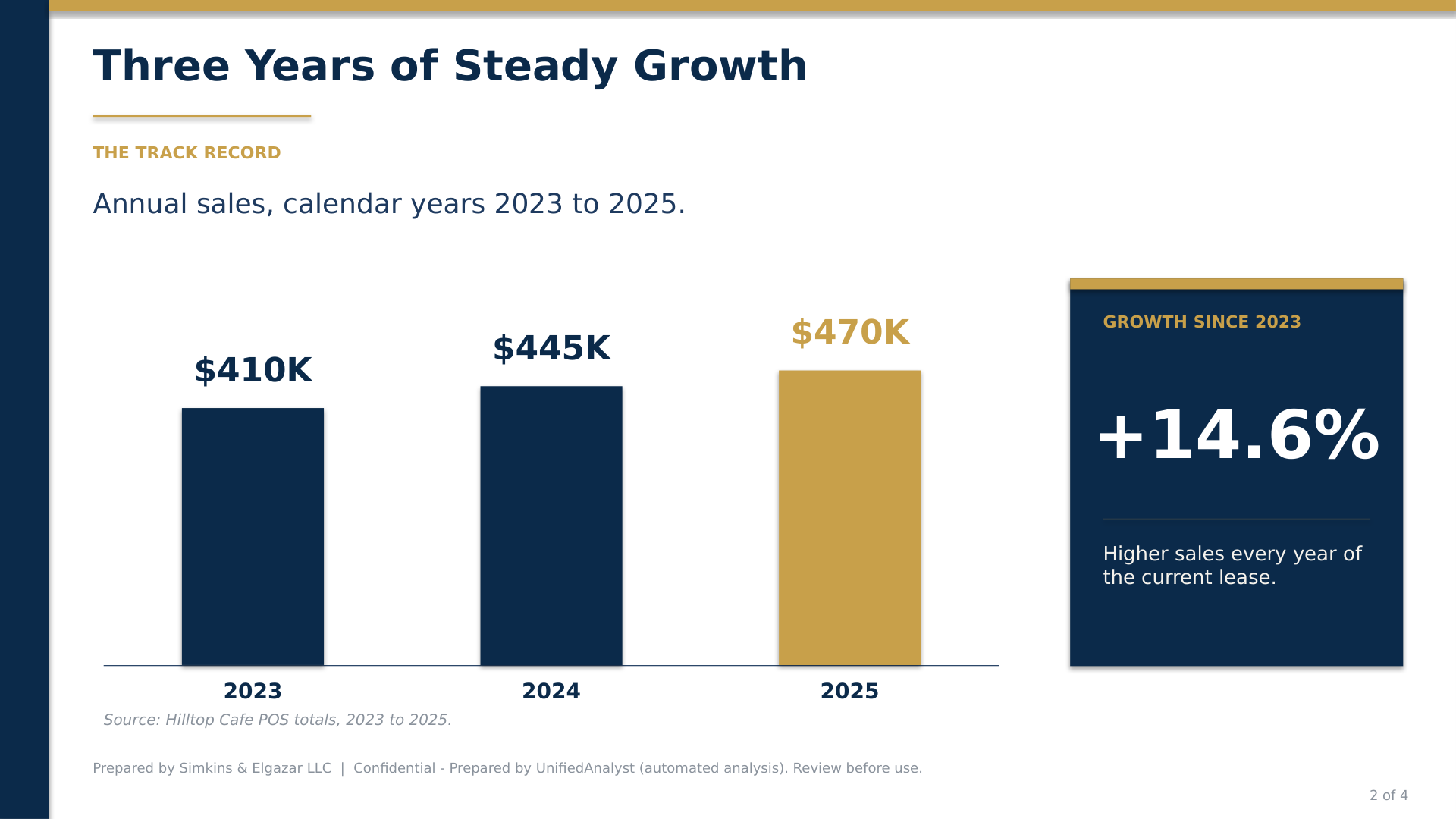
Four slides, navy, in the order asked for, four and a half minutes later. One sentence of correction afterwards edited the finished deck.
See all twelve, with the files that went in and the files that came out
What the same work costs the usual way
These are other people's published prices, not our estimates. A plan here starts at $99 a month for eight finished pieces of work.
| The job | Usual price |
|---|---|
| Cleaning up a messy transaction export Merritt Bookkeeping, catch up work | $200 per month of history |
| A twelve month budget model Bookkeeper360, per project | $2,000 |
| Bookkeeper time, by the hour Bench, certified bookkeeper rate | $55 an hour |
| A fractional CFO on retainer Pilot, entry plan | $1,750 a month |
You still review what comes back. That part stays yours, and it takes minutes instead of hours.
Try it on real work
Three full tasks free, on your own files. Run one you already know the answer to.